JILPT Research Report No.235
Work Styles and Life/Health Issues: Analysis of the JILPT’s Longitudinal Survey of Individuals (JILLS-i)
March 31, 2025
Summary
Research Objective
Japan’s economy and society are undergoing significant changes due to the declining and aging population, falling birth rates, and progress in digital transformation. These changes are accelerating under the enormous impact of the COVID-19 pandemic. Under such circumstances, people’s working styles, lives, and health are facing new situations and challenges, such as the expansion of telework and attention paid to side jobs and multiple job holding. While the prevention of death from overwork remains an important policy issue, workload factors that cause health disorders among workers are wide-ranging. They include not only long working hours but also irregular working schedules or harassment. Accordingly, the criteria for recognizing occupational accidents and diseases have been revised. However, considering workers’ health in a broad sense involves not only work and the workplace environment but also significant non-work-related factors such as family life and lifestyle habits. Consequently, empirical studies must use appropriate analytical methods to carefully examine and discuss their causal relationships. How working styles, such as telework and working nonstandard hours, affect family life and health status is also a topic that needs to be examined. Based on such situation and awareness, we planned, conducted, and analyzed an individual panel survey of individuals aged 35–54 living in Japan for the main purpose of analyzing the relationships between work (occupational characteristics, working styles, workload, etc.) and life, health, and well-being. This report compiles papers that analyzed the data of the first to third waves.
Research Method
Japan Institute for Labour Policy and Training Longitudinal Survey of Individuals (abbreviated JILLS-i)
- Web survey (Questionnaire survey using an online panel of survey company)
- Survey target: Individuals aged 35–54 living in Japan at the time of the first wave
- Sampling design: The sample size for the first wave was 20,000. To reflect the overall population distribution, based on the 2020 Population Census conducted by the Ministry of Internal Affairs and Communications, samples were allocated by gender (two categories), by age group (four categories in five-year increments), by employment status (four categories of regular employees, non-regular employees, self-employed, and non-employed), by area of residence (eight categories), and by educational background (two categories of university graduates and non-university graduates). Data were collected as designed.
- Survey period: first wave (January 18–25, 2023), second wave (July 24–31, 2023), third wave (January 22–February 7, 2024)
- Of the 20,000 respondents in the first wave, 15,573 provided valid responses in the second wave (a retention rate of 77.9%), and 15,376 in the third wave (76.9%). The number of respondents who participated in all three waves was 13,891 (an overall retention rate of 69.5%).
Key Findings
- Chapter 1. Response trends for basic items: Focusing on gender differences
This chapter presents a basic aggregation of data for basic items (employment status, working environment, time use, health status, life satisfaction, etc.) in the first to third waves, with a particular focus on gender differences. In addition to the status at the time of the third wave, including work- and life-related events (Figures 1 and 2), the analysis considers the changes in responses across all the first to third waves and the aggregation of survey items newly introduced in the second and third waves. - Chapter 2. Occupational characteristics and health: An analysis linking Japanese O-NET data to survey data
By matching numerical data from the Japanese O-NET (now called the occupational information website “job tag”) to JILPT survey data, we examined the occupational characteristics related to health. Specifically, we first conducted a principal component analysis on the numerical information for all items (80 items) regarding “work activities” and “work context” in the Japanese O-NET and extracted five principal components related to occupational characteristics (“authority,” “physical demands,” “interpersonal work,” “accuracy requirements,” and “production-line work”). Then, physical symptoms (SSS-8) and mental health (K6) were used as dependent variables to analyze their relationship with occupational characteristics (five principal component scores). The analysis indicated that the occupational characteristic of “authority” is related to better health conditions regarding both physical symptoms and mental health, suggesting that occupational characteristic possessing authority may serve as a mitigating factor against health risks. Occupational characteristics, such as “physical demands” and “interpersonal work,” were associated with physical symptoms. The occupational characteristic of “production-line work” was associated with poor mental health. It was suggested that these occupational characteristics may affect the physical and mental health of workers depending on their workload. In the supplementary section, the relationship between task characteristics, and health and wages are examined, based on the task approach. While the polarization of tasks in the labor market since the 1990s has been pointed out, we have confirmed that there are notable differences in working conditions even for tasks that are similarly subject to increasing demand. - Chapter 3. Relationship between mental and physical health deterioration risks and intragenerational mobility: Differences in occupational classes between first and current jobs
We analyze how intragenerational mobility from first jobs to current jobs affects health, focusing on mental health and physical symptoms. Some studies in Europe in recent years have pointed out that the effects of intragenerational mobility are more likely to strongly manifest in physical health than in mental health. On the other hand, the analysis in Chapter 3 confirmed trends that have not been seen in European studies, such as a trend that mental health is more susceptible to intragenerational mobility and another trend that the influence of upward or downward hierarchical mobility on health differs depending on specific starting and ending points. We examined these analysis results in light of current health disparities and occupational classes in Japan and discussed challenges and analytical policies that future studies should address in order to link these results to policy implications. - Chapter 4. Associations of nonstandard work schedules with sleep duration on weekdays and weekends
In this chapter, we investigated the associations of four types of nonstandard work schedules (NWSs) (evening, morning, both morning and evening, and night schedules) with sleep duration on weekdays and weekends, and weekend catch-up sleep. Compared to daytime work schedules, all four types of NWSs increased the risk of short sleep duration (<6 h) on weekdays. The probability of having a normal sleep duration (6–8 h) was highest among daytime workers, lowest among both morning and evening workers and night workers. The probability of having a normal sleep duration among morning workers and evening workers was lower than daytime workers and higher than both morning and evening workers and night workers. Additionally, night schedules were associated with an increased risk of long sleep duration (≥8 h) on both weekdays and weekends. Moreover, NWSs were also found to be related to higher likelihood of extending sleep on weekends. The findings suggest that besides reducing working hours, improving work time arrangement is necessary to promote sleep health. - Chapter 5. Telework in the Post-COVID-19 era
We analyzed the status of telework implementation after the COVID-19 era and changes in time use accompanied by changes in the number of telework days. Using the panel data from the first to third waves, it takes advantage of the panel survey that can track situations before and after the reclassification of COVID-19 as a Class 5 infectious disease in May 2023. The analysis confirmed a trend of returning to the office, noting that telework has generally declined in the post-COVID-19 era. However, looking at telework retention rates, telework has been more likely to continue among university graduates, professionals, and residents of the Tokyo metropolitan area. The analysis also indicated that companies that implement work-life balance support measures are more likely to retain telework, suggesting that companies’ employment management policies are related to the retention of telework in the post-COVID-19 era. Furthermore, an analysis of changes within the same individual in the relationship between the retention of telework and the allocation of time use indicated that changes in the number of telework days were associated with changes in housework time only among women. This suggest that the choice of working style is related to the gender division of labor in the post-COVID-19 era. - Chapter 6. Job quality and union membership status
In recent years, labor policy across countries has increasingly emphasized not only the “quantity of work,” which has traditionally been the main focus, but also the “quality of work.” However, there has been little empirical research on how the presence of labor unions in the workplace and individual union membership is related to workers’ job quality. Drawing on the OECD framework of job quality, this paper analyzes how both the presence of a labor union at the workplace and union membership status are associated with individual job quality. The results do not indicate a clear overall association between labor unions and job quality. However, a more detailed analysis reveals several important patterns. When “workload” is divided into two components—job demands and job resources—labor unions, which are conventionally thought to negotiate over job demands, are in fact more closely associated with higher levels of job quality. Notably, however, these relationships are observed primarily in small- and medium-sized enterprises, while in large firms the presence of labor unions shows little independent effect on job quality. These findings suggest the need for a multifaceted examination of how labor unions can demonstrate their significance in contemporary labor markets.
Figure 1. Work-related events in the past six months (Third Wave) by gender
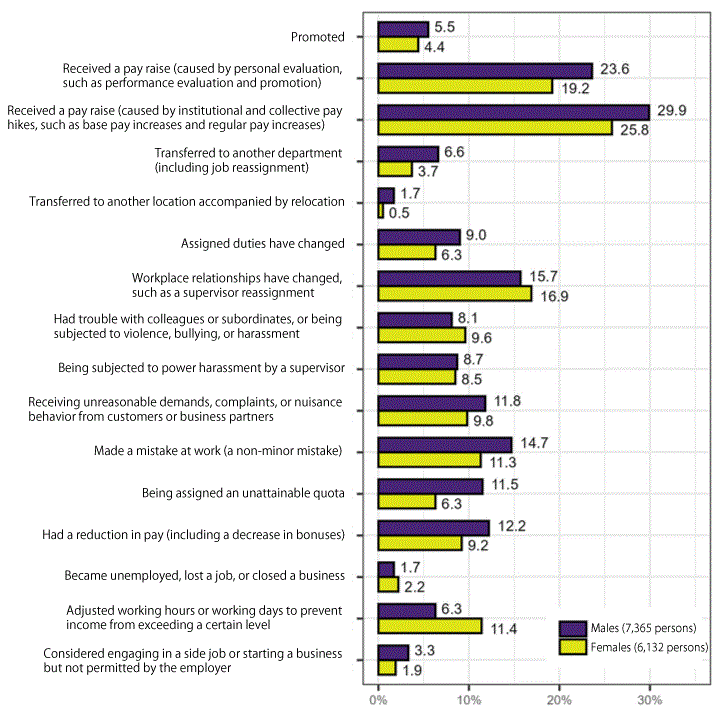
Notes: 1. Data were aggregated for respondents who participated in the third wave and had work experience in the past six months.
2. Percentage values in the figure are rounded to the second decimal place.
Figure 2. Everyday life events in the past six months (Third Wave) by gender and age group
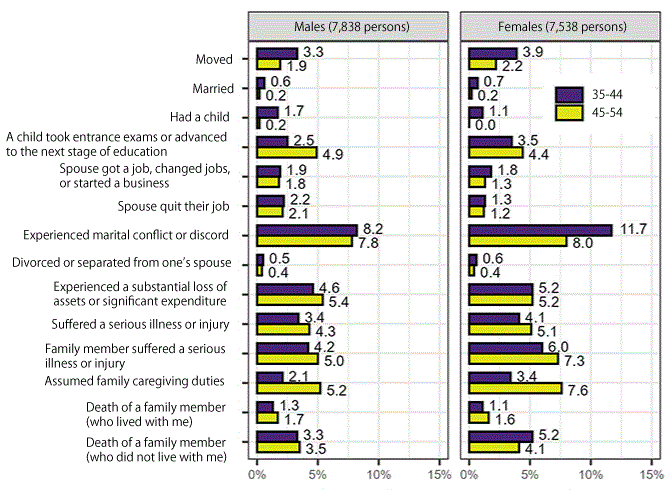
Notes: 1. Data was aggregated for respondents who participated in the third wave. Ages are based on the first wave.
2. Percentage values in the figure are rounded to the second decimal place.
Policy Implications
Each chapter focuses on the life and health of workers and the quality of work and provides implications for the working environment, occupational characteristics, and challenges in professional careers. In order to improve health and well-being in society, it is important to understand situations and challenges faced by individuals with regard to work, life, and health.
Contents
JILPT Research Report No.235, full text (PDF:14.8MB) [in Japanese]Category
Research Period
FY 2022–24
Author
- TAKAMI Tomohiro
- Senior Researcher, The Japan Institute for Labour Policy and Training (JILPT)
- SUZUKI Kyoko
- Researcher, JILPT
- TORII Yuki
- Assistant Fellow, JILPT
- KOMATSU Kyoko
- Researcher, JILPT
- YAMAMOTO Yuzo
- Professor, Kyushu International University
- WANG Huilin
- Researcher, National Institute of Occupational Safety and Health, Japan
- KOBAYASHI Hideyuki
- Associate Professor, University of Kochi
- TAKAHASHI Masaya
- Director, Research Center for Overwork-Related Disorders, National Institute of Occupational Safety and Health, Japan
- NAKAMURA Akie
- Senior Researcher, JTUC Research Institute for Advancement of Living Standards
For Citation
The Japan Institution for Labor Policy and Training. 2025. Hatarakikata to seikatsu kenko no kadai: JILPT kojin paneru chosa no bunseki [Work Styles and Life/Health Issues: Analysis of the JILPT’s Longitudinal Survey of Individuals]. JILPT Research Report no. 235.
Related Research
- Survey Series No. 234 “JILPT’s Longitudinal Survey of Individuals: First Survey on Work, Life and Health” (2023)
- Discussion Paper 24-03 "Diversity of Working Styles from the Perspective of 'Work Quality'" (2024)
JILPT Research Report at a Glance
  |
To view PDF files, you will need Adobe Acrobat Reader Software installed on your computer.The Adobe Acrobat Reader can be downloaded from this banner. |