JILPT Research Report No.234
Realities and Trends of Stratification Among Single-Mother Households: Challenges for Economic Independence and Children’s Well-Being
March 31, 2025
Summary
Research Objective
The purpose of this report is to discuss the direction of future policies concerning the economic independence of single-mother households. Previous research on single-parent households has focused on three perspectives: (1) social security systems and poverty, (2) women's labor and employment support, and (3) divorce and parent-child relationships. Drawing on quantitative analyses of the JILPT National Survey of Households with Children (2011–2022), this report examines these three perspectives and identifies key issues related to the economic independence of single mother households and the well-being of their children.
Research Method
Secondary analysis using the combined data from the National Survey of Households with Children (2011–2022).
Key Findings
- The perspective of social security systems and poverty
- The perspective of women's labor and employment support
- The perspective of divorce and parent-child relationships
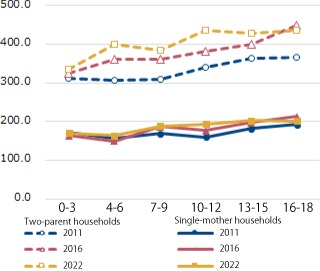
Chapter 1 indicates that while the economic situation of single-mother households has improved over the past decade, when viewed in terms of relative position among households with children, the economic situation of single-mother households has actually worsened (Figure 1). Moreover, in recent years among impoverished single-mother households, there has been a notable bias showing a particularly significant increase in the proportion of mothers whose first job was non-regular employment. Chapter 2 indicates that while two-parent households tend to see an increase in income as they progress through the stages of life, this trend is scarcely observed in single-mother households. Consequently, income disparities between households tend to widen in the later stages of life (Figure 2). Furthermore, as only two-parent households have seen income growth, the income gap between households has expanded in recent years. Chapter 3 indicates that while the 2018 revision to the Child Rearing Allowance (which raised the income threshold for full benefits) has increased the number of single-mother households receiving full benefits, it has not led to improvements in the poverty rate among single-mother households as a whole or in their ways of working.
Figure 1. Trends in poverty rates (Definitions A–C): By household type
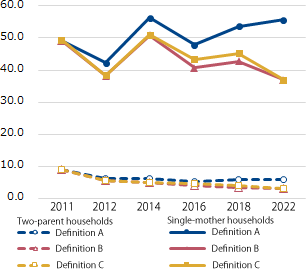
Note: The definition of the poverty rate is: (A) less than 50% of the median equivalized household income within each year's data, (B) the real value of less than 50% of the median equivalized household income from the 2012 data (income for each year is the real value of equivalized household income), (C) less than 50% of the median equivalent household income of all households in each year from the Ministry of Health, Labour and Welfare's Comprehensive Survey of Living Conditions.
Figure 2. Average adjusted income by year and stages of life, categorized by household structure (in 10,000 yen)
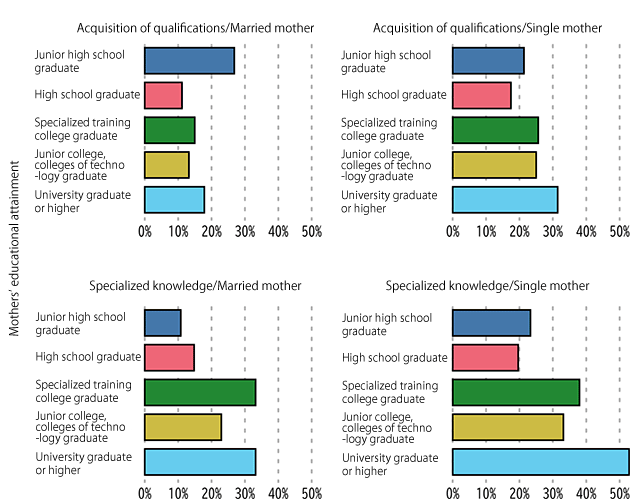
Chapter 4 indicates that the employment structures differ between single mothers of high school graduates or less and those of junior college graduates or higher. Significant differences exist particularly in employment status, occupation, and career patterns. While single mothers of high school graduates or less show a notably increased prevalence of “persistently atypical employment” careers, those of junior college graduates or higher exhibit an increase in “continuous regular employment” careers (Figure 3). Furthermore, this disparity in employment structures between educational attainments leads to wage gaps. Chapter 5 indicates that, compared to fathers, both single mothers and married mothers are more likely to work in clerical and professional roles and have higher employment rates in the healthcare, welfare, and education sectors while having lower proportions of managerial positions, lower employment rates in manufacturing and public service, and a lower percentages of single-company continuous careers. In addition, even within the same educational stratification, occupational level, industrial sector, and long-term employment status, single mothers and married mothers earn lower annual incomes than fathers. Chapter 6 indicates that even after controlling for differences in employment status and educational attainment, single mothers have a higher rate of engaging in self-development activities compared to married mothers, particularly among employed single mothers with a junior college degree or higher (Figure 4). Furthermore, among single mothers with junior college degree or higher, the correlation between self-development activities and experience or intention to use public vocational training is relatively weak. Chapter 7 indicates that the probability of achieving an annual income of 3 million yen or more—a benchmark for economic independence in single-mother households—is 9.5 percentage points higher among participants in the higher vocational training promotion benefit program than among non-participants. However, no significant impact of training participation on overall employment annual income was confirmed.
Figure 3. Occupational distribution by birth cohort and educational attainment among single mothers
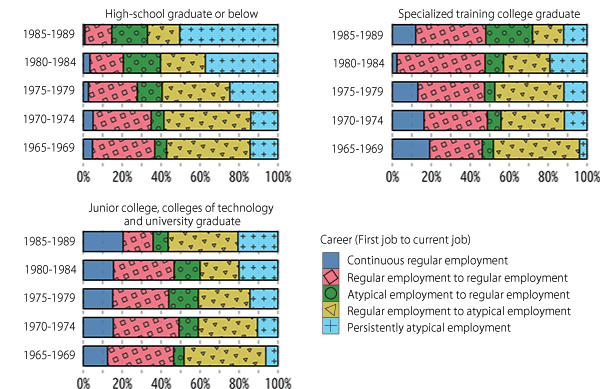
Figure 4. Comparison of self-development implementation rates by household and educational attainment (among persons engaged in work)
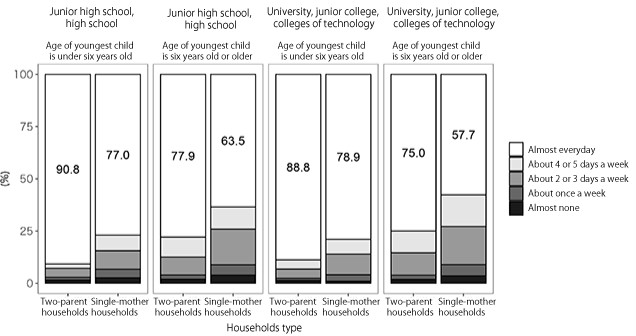
Chapter 8 indicates that household income within single-mother households varies by educational stratification, with higher-educated single-mother households having relatively higher household income. Regardless of educational attainment, time investment in children is low in single-mother households (Figure 5), but educational investment in children does differ by mothers’ educational attainment. Chapter 9 indicates that when controlling for factors such as the mother's age and stages of life (age of the youngest child), mothers with higher educational attainment group rather invest less time in their children than mothers with lower educational attainment group. The disparity in time investment in children between first-marriage households and remarried households is particularly large among the higher educational attainment group. In addition, remarried households invest less time in their children than first-marriage households. Chapter 10 indicates that working mothers experience slightly more child neglect than non-working mothers, but there are no differences based on employment status or occupational career. Compared to two-parent households, single-mother households experience more excessive physical punishment and child neglect.
Figure 5. Frequency of mothers eating dinner with their children by household type, mother's educational attainment, and age of the youngest child
Policy Implications
This report concludes that the single-parent households policies of the past decade have not entirely been ineffective in achieving economic independence through employment. Rather, it can be said that they lacked sufficient strength to enable single-mother households as a whole to achieve economic self-sufficiency amid widening stratification. Employment support measures in the form of strengthening the vocational skills development are effective only for a limited segment of the population, and their contribution to addressing time poverty—beyond economic poverty—is limited. In order for single-mother households to achieve “independence” in a comprehensive sense—encompassing both economic and non-economic dimensions—it is necessary to consider in the comprehensive structure based on a balance of social security (welfare) and labor policy (employment), and further developing of family policy. The implications of each policy are as follows.
- The perspectives on women's labor and employment support
Given that the characteristics of single mothers, many of whom are high school graduates and are likely to start their careers in non-regular or service sector jobs, policy interventions tailored to these characteristics are crucial. This represents a clear divergence from the typical image of “college graduates starting in regular white-collar positions” assumed by equality, work-life balance, and women's advancement policies. Therefore, strengthening these policies for women from lower educational attainment group can contribute to the economic independence of single mothers. Furthermore, since individuals from low educational attainment face disadvantages early in their careers, it is crucial to develop second chance opportunities in the labor market —such as greater ease of transitioning to better-paying jobs—to allow them to overcome these early setbacks. One example is leveraging active self-development and other forms of workers’ autonomous skills development among single mothers. The higher vocational training promotion benefit program, which is expected to foster such workers’ autonomous skills development, has proven effective in helping single-mother households achieve a certain level of economic independence. However, there is a mismatch between the demand for this program and the available options within the system, and resolving this mismatch is crucial.
Overall, the economic independence of single mothers achieved through employment support—which gained prominence during the shift from welfare to work since the 2000s—can be evaluated as having had a positive effect, at least for highly educated single mothers. However, it is important to recognize that many single mothers come from lower educational attainment group and are institutionally and structurally positioned in labor market positions where they gain little benefit from such policies which means there exists a group for whom achieving economic independence through employment alone is difficult.
- The perspective of social security systems and poverty
While the overall poverty risk for single-mother households has improved on average, the characteristics of poor single-mother households have recently shifted toward those facing more difficult economic circumstances. Given that a divergence has emerged within single-mother households between those who are able to escape poverty and those who are not, it is important to adopt differentiated approaches tailored to each group—those who are closer to escaping poverty, and those for whom doing so remains difficult. Raising the income threshold for full Child Support Allowance benefits is thought to have a significant impact on the group closer to escaping poverty, acting as the final push needed. At the same time, it is important to reconsider the nature of income security and social security systems for the segment of single-mother households that still face significant difficulties in escaping poverty today. The absence of a rising income trend associated with life stages makes it difficult for single-mother households to cope with the poverty risks arising from life stage transitions. This calls for social security systems, such as income redistribution, that are designed with the recognition for the fact that the economic situation of single-mother households tends to worsen in the later stages of life.
- The perspectives of divorce and parent-child relationships
Single-mother households commonly face insufficient time investment in their children. Even among highly educated groups, who are relatively closer to escaping economic poverty, escaping time poverty is not so straightforward. This raises questions about whether achieving economic independence through employment entails accepting time poverty. It necessitates questioning the structural limitations inherent in the policy shift from welfare to employment. Regardless of household type, there is a strong tendency for serious problems to arise in parent-child relationships, such as higher rates of child abuse experienced by children of working mothers. This background is influenced by the fact that mothers, regardless of household type, commonly face the dual burden of earning roles and care roles. For single-mother households in particular, these two roles can have a significant impact on the household. It is therefore necessary to provide the support from a family welfare perspective, so that the pursuit of economic independence does not come at the cost of the parent-child relationship.
Contents
JILPT Research Report No.234, full text (PDF:7.6MB) [in Japanese]
Category
Workers' life/workers' awareness, Working conditions/work environment, Human resources management/vocational skills development
Research Period
FY 2023—2024
Authors
- TAGAMI Kota
- Researcher, The Japan Institute for Labour Policy and Training (JILPT)
- IKEDA Shingou
- Vice Research Director, JILPT
- TIAN Xia
- Assistant fellow, JILPT
For Citation
JILPT. 2025. Boshi setai no kaisoteki bundan no jisso to susei—Keizaiteki jiritsu to kodomo no weru bi-ingu no kadai [The Reality and trends of social stratification among single-mother households—Challenges of economic independence and children's well-being]. JILPT Research Report no.234. Tokyo: The Japan Institute for Labour Policy and Training.
Related Research
- JILPT Research Report No.159, Women Fighting to Balance Between Child-rearing and Work: Re-analysis of the JILPT National Survey of Households with Children 2011 (2013)
- JILPT Research Report No.189, Distress in Childrearing Households (2017)
- JILPT Research Report No.208, Disparities Associated with Work and Child-Rearing (2021)
- JILPT Research Material Series No.146, Wellbeing of Child-Rearing Households: Focusing on Mothers and Children (2015)
- JILPT Research Series No.95, Survey on Living Standards of Households with Children and the Employment Status of Their Parents (2012)
- JILPT Research Series No.109, Survey on Living Standards of Households with Children and the Employment Status of Their Parents 2012 (the 2nd National Survey of Households with Children) (2013)
- JILPT Research Series No.145, Survey on Living Standards of Households with Children and the Employment Status of Their Parents 2014 (the 3rd National Survey of Households with Children) (2015)
- JILPT Research Series No.175, Survey on Living Standards of Households with Children and the Employment Status of Their Parents 2016 (the 4th National Survey of Households with Children) (2017)
- JILPT Research Series No.192, Survey on Living Standards of Households with Children and the Employment Status of Their Parents 2018 (the 5th National Survey of Households with Children) (2019)
- JILPT Research Series No.239, Survey on Living Situations of Households with Children and the Employment Status of Their Parents 2022 (Basic tabulation of the 1st to 6th National Survey of Households with Children) (2024)
JILPT Research Report at a Glance
  |
To view PDF files, you will need Adobe Acrobat Reader Software installed on your computer.The Adobe Acrobat Reader can be downloaded from this banner. |