JILPT Research Report No.236
Evaluating Special Measures for Employment Adjustment Subsidy during the COVID-19 Crisis
June 30, 2025
Summary
Research Objective
This study conducts an evaluation of the special measures for the Employment Adjustment Subsidy (EAS) introduced in response to the impact of the Novel Coronavirus Disease (the “COVID-19 Special Measures”) to examine whether they adequately fulfilled the role initially anticipated. Using a dataset that links administrative records on EAS and employment insurance (hereinafter, administrative records) with data from a business establishment questionnaire survey, the study assesses the impact of these measures from multiple perspectives. Specifically, the analysis focuses on the following questions. First, in the context of the prolonged impact of the COVID-19 pandemic, what types of firms utilized the special EAS measures, which are maintained over time while being gradually scaled back, and what effects did they have on firms, workers, and the labor market? Second, did the measures in fact achieve their intended employment retention effects? Third, based on the findings, how should the EAS be designed and positioned as part of the labor market policy infrastructure?
Research Method
Aggregation and secondary analysis based on the administrative records and the business establishment questionnaire survey (“Survey on Utilization of the COVID-19 Special Measures for Employment Adjustment Subsidies”)
Key Findings
- The scale of the EAS was considerable, exceeding that observed during the Great Recession triggered by the collapse of Lehman Brothers. It was implemented across a wide range of industries and sustained over a prolonged duration.
- EAS demonstrated a certain degree of effectiveness in employment retention. Although this effect is most pronounced in the initial stages, its efficacy appears to diminish as utilization extends over longer durations.
- Vocational training funded by the EAS demonstrated a certain level of effectiveness in promoting employment retention when implemented early in the COVID-19 period. However, when implemented later in the pandemic or over the long term, its effectiveness diminished, resulting in limited employment retention outcome.
- Displaced workers from recipient establishments generally experienced longer non-employment durations prior to re-employment than those from non-recipient establishments.
- The emergency employment security subsidy (Kinkyu koyo antei joseikin), introduced as a special measure to maintain employment among non-regular workers, proved to be moderately effective. Its impact, however, was more limited in scope and slightly weaker than that of the EAS.
- Administrative procedures were promptly streamlined, and the system was generally well publicized, except for certain parts.
Limitations of Evaluation and Challenges
It proved difficult to evaluate the effectiveness of the specific details of the COVID-19 special measures, such as raising subsidy rates or maximum amounts, and no conclusion was reached. Furthermore, limitations in the evaluation were identified, as well as future challenges, including the need for evaluating medium- to long-term effectiveness and accumulating know-how, updating analytical perspectives, such as examining the relationship with wages, preparing administrative records for evaluation purposes, and the need for further accumulation of research.
Figure 1. Share of business establishments receiving subsidies among those covered by employment insurance
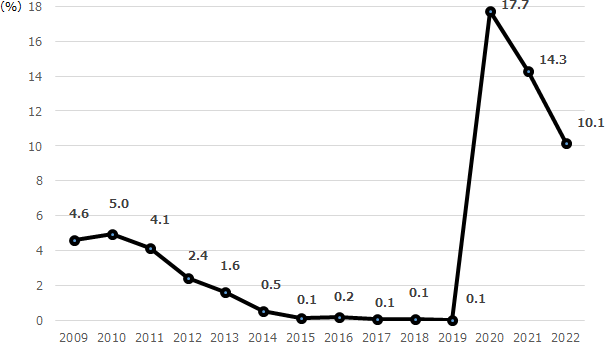
Looking at the proportion of business establishments receiving EAS relative to all establishments (those covered by employment insurance), approximately 18% received subsidies in 2020, approximately 14% in 2021, and approximately 10% in 2022 —figures that are all higher than the peak of 5.0% reached in 2010 during the Great Recession, triggered by the collapse of Lehman Brothers in 2008.
Figure 2. Survival rate of business establishments in highly impacted industries after the termination of EAS receipt, by year of termination
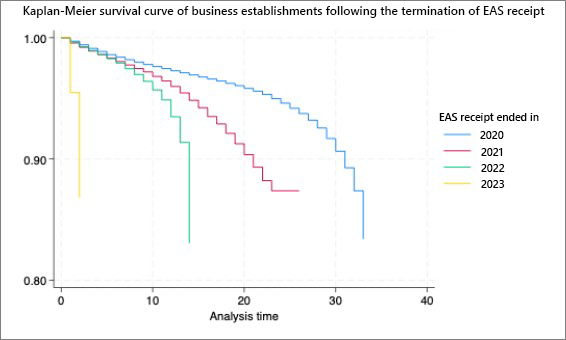
Examining the survival probability of business establishments that received EAS following the end of their subsidy period, approximately 15% of establishments closed during the survey period. Business establishments that received subsidies for a longer duration tended to exit the market more quickly.
Policy Implications
- The Employment Adjustment Subsidies provided effective emergency relief and demonstrated its intended employment retention effectiveness during the shock period. However, its effectiveness tends to diminish as the receiving period extends. Given these findings, while the subsidy system itself holds significance, measures should be implemented to prevent prolonged usage. This could include limiting the special measures period to a predetermined duration or establishing maximum application periods for individual business establishments.
- Regarding non-regular workers, when implementing emergency employment security subsidy to maintain employment, efforts should focus on the dissemination of information to small businesses. Additionally, it is advisable to consider alternative support measures as a future task in cases where employment cannot be maintained.
- To facilitate effective, efficient, and timely evaluations of policy effectiveness, it is desirable to advance preparation for the organization of administrative records data, the review of data elements, and integration of such data with other administrative records datasets, in line with ongoing efforts toward digitization and administrative streamlining.
Contents
JILPT Research Report No.236, full text (PDF:7.0MB) [in Japanese]
Category
Employment/unemployment, Novel Coronavirus (COVID-19)
Research Period
April 2021—March 2025
Author
- TAKAMATSU Toshimitsu
- Research Director, JILPT
- IWATA Toshihide
- Deputy Senior Research Officer, JILPT
- KAWAKAMI Atsushi
- Professor, Economics Department, Toyo University
- KAMBAYASHI Ryo
- Professor, Labor Economics, Musashi University
- HE Fang
- Vice Senior Researcher, JILPT
- TAKAHASHI Koji
- Senior Researcher, JILPT
- MORIYAMA Tomohiko
- Vice Senior Researcher, JILPT
- SASAKI Masaru
- Professor, Graduate School of Economics, The University of Osaka
- HIGASHI Yudai
- Associate Professor, Economics, Kyoto Sangyo University
- KOBAYASHI Toru
- Professor, Economics, Takasaki City University of Economics
(Titles and affiliations are as of the time of publication.)
For Citation
JILPT. 2025. Shin-gata korona uirusu kansensho no eikyo ni tomonau koyo chosei joseikin no tokurei sochi no koka kensho ni kansuru kenkyu [Evaluating Special Measures for Employment Adjustment Subsidy during the COVID-19 Crisis]. JILPT Research Report no. 236. Tokyo: The Japan Institute for Labour Policy and Training.
Related Research
- Overseas labor affairs information 22-10, “Employment Retention Policies in Various Countries: United States, United Kingdom, Germany, France” (2022) [in Japanese]
- JILPT Research Material Series No.265, Actual Payment Status of the Employment Adjustment Subsidies (2023)
- JILPT Research Series No.238, Survey on Utilization of the COVID-19 Special Measures for Employment Adjustment Subsidies (2024)
- JILPT. Results of “the Effectiveness Evaluation of the COVID-19 Special Measures for Employment Adjustment Subsidies (Preliminary Report)” press release, May 12, 2025. (PDF:1.5MB) [in Japanese]
JILPT Research Report at a Glance
  |
To view PDF files, you will need Adobe Acrobat Reader Software installed on your computer.The Adobe Acrobat Reader can be downloaded from this banner. |