JILPT Research Report No.225
Volunteering and Social Contribution Activities by Corporate Employees: The Potential of Parallel Career
April 6, 2023
Summary
Research Objective
The purpose of this report is to clarify the characteristics of corporate employees who take part in volunteering and social contribution activities, identify what kind of people wish to take part in the future and what they expect from companies, and analyze the direction companies should take as mediators to promote these activities. This report uses data from the Jinsei 100 nen jidai no kigyoujin to shakai koken katsudo ni kansuru anketo [Survey on corporate employees and social contribution activities in the age of 100 years of life] conducted by JILPT in 2018 and 2019, undertaking a secondary analysis according to a deeper theme.
In the introduction, we discuss definitions, historical background, benefits, and challenges from earlier studies on corporate volunteering, and show the direction that corporate volunteering and social contribution activities in Japan should take. It also provides an overview of the survey used in this report. Chapter 1 explores the factors that contribute to the wish to take part in volunteering and social contribution activities, looking in particular at the relationship between past volunteer experiences and current work. Chapter 2 searches for trends toward volunteer participation by generation and sex and discusses whether a single-line career can become a complementary career through activity participation. Chapter 3 analyzes the relationship between the working-age population’s various anxieties about later life and participation in social contribution activities. Chapter 4 examines the relationship between the job performance skills of corporate employees and their participation in volunteer activities. Chapter 5 examines the relationship between the perceptions of volunteering and NPOs and volunteer participation. Chapters 4 and 5 rely on a psychological approach. Chapter 6 focuses on the motivations of corporate employees for volunteering, the continuation and frequency of the activities, and discusses measures that would be beneficial to both the company and its employees. The final chapter summarizes the findings of each chapter and provides support measures for employees and implications when companies promote volunteering and social contribution activities.
Research Method
For the analysis in this report, data from the Jinsei 100 nen jidai no kigyoujin to shakai koken katsudo ni kansuru anketo [Survey on corporate employees and social contribution activities in the age of 100 years of life] conducted by JILPT was used. A comparative analysis of two sets of survey data, one from the Kigyo 6 sha jugyoin chosa [Survey of Six Corporate Employees] (hereinafter referred to as the “Corporate Employee Survey”) and the other from the Web Monitor Survey (hereinafter referred to as the “Monitor Survey”) of employees working for typical large companies, has been conducted in an effort to show trends and generalities in each. In all, 16,015 responses were collected for the Corporate Employee Survey, while 3,831 responses were collected for the Monitor Survey.
Key Findings
1. Chapter 1
Do volunteer experiences lead to future volunteer activities?: A study based on the relationship with work and work styles
Chapter 1 analyzes the factors that lead to future volunteer participation from the perspectives of volunteer experience, work and work style. The results of the analysis of the attributes of those with volunteer experiences show a trend that women, those with children, and younger age groups are more likely to have taken part in volunteer activities. In particular, volunteer activities during student years is more common among younger cohorts in their 20s and 30s. Analysis of the attributes of those who wish to take part in volunteer activities in the future shows a trend toward women, middle-aged and older groups.
Looking at the relationship with work style, those who wish to participate in volunteer activities generally tend to work longer overtime hours, and those who have higher levels of job satisfaction (wages or income, working hours, holidays or vacations) and those who feel themselves highly evaluated by the company are more likely to wish to take part in volunteer activities.
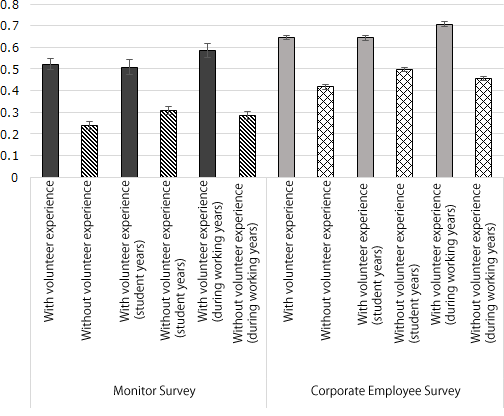
Looking at the impact of volunteer experience on the wish to take part in volunteer activities in the future, it was found that those with volunteer experience were 20–30% more likely to wish to take part in such activities, with the impact of experience after entering the workforce being particularly significant (Figure 1).
Among those with volunteer experience, people with voluntary motivation were more likely to express a future intention to take part than those with obligatory motivation; on the other hand, the likelihood of future participation for those with obligatory motivation was almost the same as that of those with no volunteer experience.
Figure 1. Volunteer experience and interest in volunteering (predicted values)
2. Chapter 2
Breaking away from social contribution activities based on first careers: Focusing on men and women of the young generation, the lost generation, and the bubble generation
In Chapter 2, we examine the possibility of a shift to volunteering and social contribution activities by dividing the axis of generational analysis into the youth generation, the lost generation, and the bubble generation of men and women, considering the changing situation in Japan’s single-line career model—where individuals graduate from school, obtain employment (first career), remain with the same company, and retire at the mandatory retirement age.
The results of the analysis suggest the following: (1) Comparing the Corporate Employee Survey and the Monitor Survey, respondents in the Corporate Employee Survey, who generally have more stability, tend to be more positive about social contribution activities while still devoting energy to their work. Nevertheless, both surveys had in common that job satisfaction and a career vision that looks ahead to retirement also increased the motivation to channel their energy into social contribution activities.
(2) In terms of generational characteristics, the bubble generation tends to show enthusiasm for various activities. In contrast, the lost generation is rather reserved, and the youth generation, focused on immediate work-centered lifestyles, does not show such a different stance toward social contribution activities compared to other generations.
(3) Regarding sexes, women were more active in social contribution activities, as has been mentioned in the past.
Those who are tightly engaged in working for a living, those who are in the child-rearing period, and the young and middle-aged are less willing to take part. When considered in terms of generations, the lost generation, who could not help but grow reluctant to do anything because of social circumstances, is passive to engage in social contribution activities as well, and effective support is needed before they reach old age. In general, those analyzed in this chapter are fortunate to secure stable employment. Paving the way for social contribution businesses by companies and their employees, whose first careers are relatively fulfilling and leisurely, is a solution that is also in line with the needs of an ever-aging society as a whole.
3. Chapter 3
Later life anxiety and participation in social contribution activities
Chapter 3 analyzes the relationship between later life anxiety and participation in social contribution activities. The analysis focuses on whether the type and intensity of later life anxiety motivate people to engage in social contribution activities and the timing of participation. The data used comes from the Corporate Employee Survey and Monitor Survey of people aged 40 to under 60 who are beginning to consider later life.
The analysis results shows that those who feel more anxious about their later life with respect to “Having meaningful work to be committed to” are more willing to engage in social contribution activities, and those who feel more anxious about their later life with respect to “Keeping social connections (e.g., local community)” are more willing to engage in social activities (Figure 2). Focusing on the timing of the start of activities, the respondents would like to engage in activities “In the next few years.” However, no statistically significant differences were seen in the intended start time among those who wish to take part.
It is suggested that those who have more anxiety about later life with respect to “Having meaningful work to be committed to” wish to participate not only “To make use of their knowledge, skills, and experience” but also “To gain skills useful for work,” and that they are willing to participate in social contribution activities earlier on average (“Within a few years” rather than “Around retirement”) to gain skills useful for work.
Figure 2. Relationship between the degree of later life anxiety and wished proactive post-retirement activities (corporate employee survey)
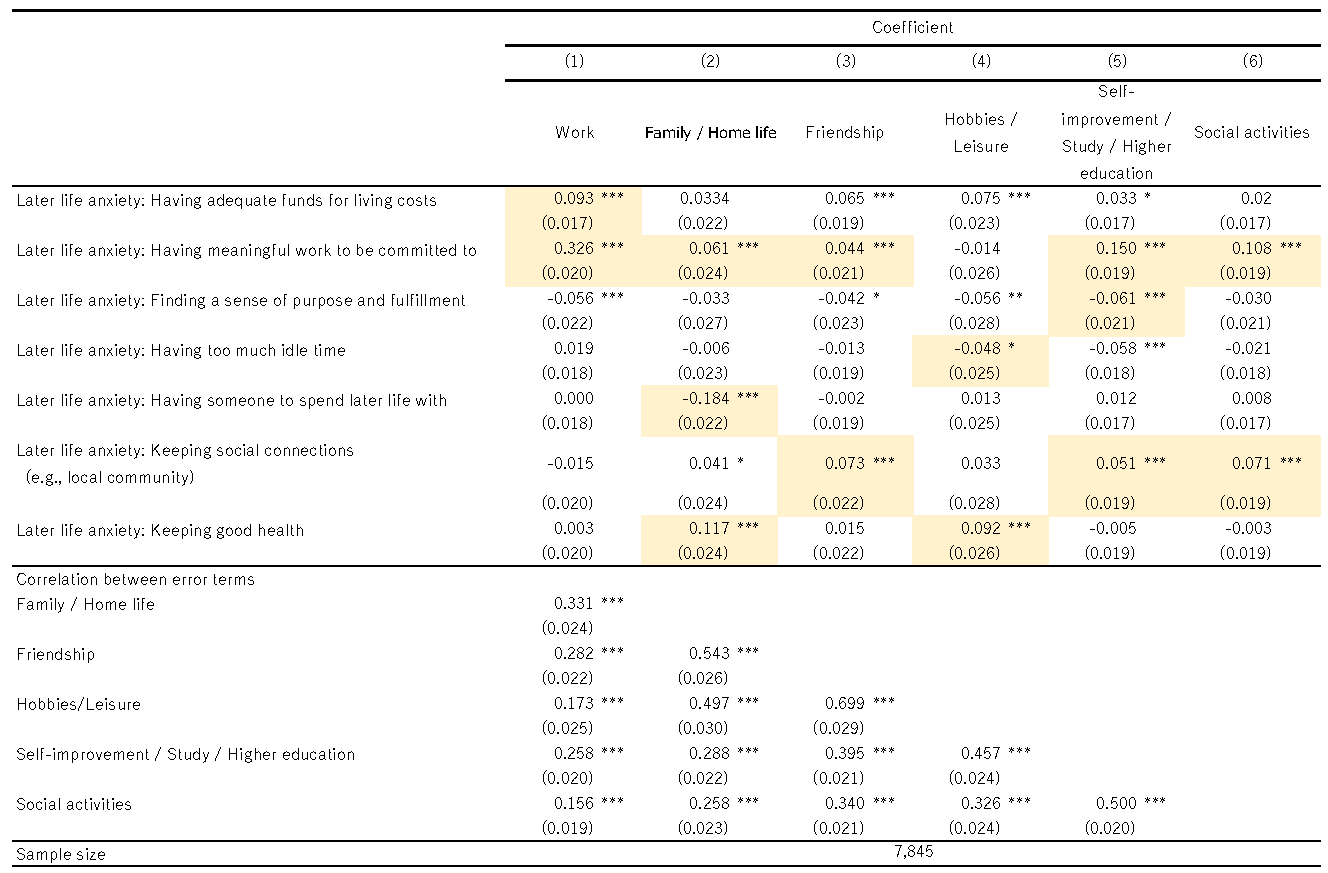
Notes: 1. Values in parentheses are standard errors clustered by individual. 2. *, **, and *** indicate statistical significance at the 10%, 5%, and 1% levels, respectively.
4. Chapter 4
The relationship between job-related skills of corporate employees and volunteering
In Chapter 4, we examine the relationship between the skills (job-related skills) that are considered to be useful in general for corporate employees in performing their jobs and their attributes or volunteer experience. The job-related skills consist of 25 items (e.g., “Directing and delegating work,” “Supporting others,” etc.), and respondents subjectively rated their ability on a five-point scale, based on their personal assessment whether they felt the skill was “Proficient” or “Not proficient.” Job-related skills were classified into four categories by factor analysis: “Project management,” “Interpersonal relations,” “Unlearning,” and “Self-management.”
Analysis results showed that men tended to be proficient in “Project management” skills while women in “Self-management” skills. About the relationship with volunteer and social contribution activities, groups with experience in these activities showed higher self-rated ability for those skills. When examined by age group, the effect was even clearer, especially for “Interpersonal relations” skills among men under 35 years of age, where having activity experience increased the ratings of ability (Figure 3). Looking at the timing of the activities, skill ratings were higher for those who had activity experience not only as students but also as working adults. Furthermore, those who had achieved some results in their activities were found to give higher ability ratings compared to those who had not.
Figure 3. Awareness of skills by social contribution activity experience, age group, and sex
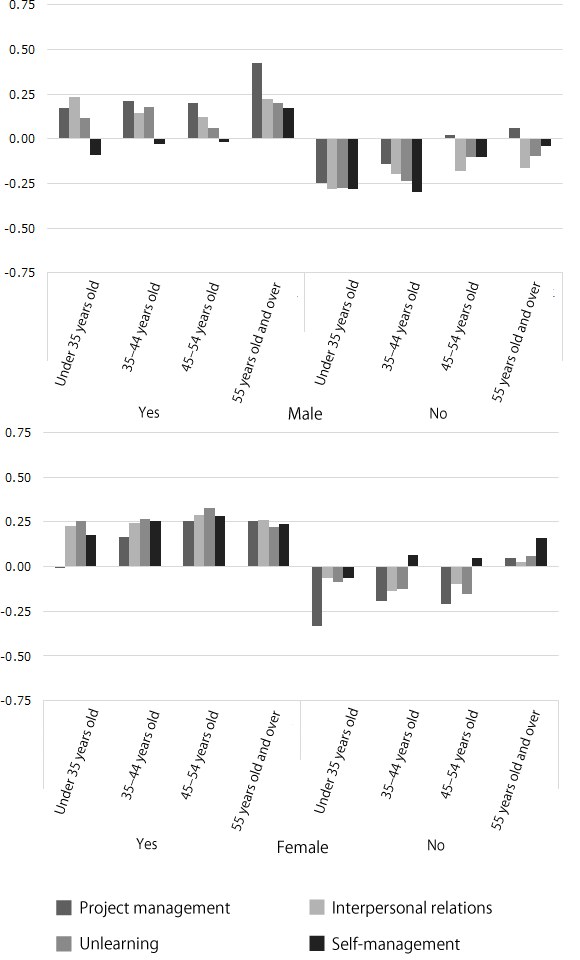
On job-related skills among corporate employees, men tended to feel proficient in “Project management” skills, while women tended to feel proficient in “Self-management” skills. The groups with experience in volunteering and social contribution activities showed higher self-ratings of skill ability than those without such experience. When examined by age group, this effect was even more pronounced; particularly for “Interpersonal relations” skills among men under 35 years of age, having activity experience was associated with higher ability ratings.
5. Chapter 5
Corporate employees’ perceptions of NPOs and their participation in social contribution activities
Based on the hypothesis that the psychological impression of NPOs and volunteer activities may influence participation behavior, Chapter 5 used the Semantic Differential (SD) method to measure perceptions of the respondent’s own company, NPOs, and volunteer organizations. The goal was to analyze trends in the relationship between “Attributes or Volunteer experience” and the “Willingness to take part in activities,” as well as “Participation triggers” and the “Use of matching systems.” Through factor analysis, the question groups were divided into two categories: the “Affinity” factor and the “Work attitudes” factor. Findings showed that the respondents’ own companies generally scored higher on both factors.
In terms of perceptions of NPOs, the group with volunteer experience tended to show a high degree of “Affinity” toward NPOs. When examining the relationship with future wish to take part in volunteer activities, groups that expressed a wish to take part also showed a high level of “Affinity” toward NPOs.
In response to the question of “Whether you would use a system that introduces and matches you with volunteer opportunities,” comparisons were made among: (a) “Public organizations (national and local governments),” (b) “NPOs, public corporations,” (c) “Private internet sites,” and (d) “One’s current company.” Respondents who answered they “Will use” the service if it were provided by (d) “One’s current company” had a high “Affinity” toward their own company but the lowest “Affinity” toward volunteer organizations and NPOs, etc. (Figure 4). In light of this, it is possible that even among groups with low “Affinity” toward volunteer organizations and NPOs, effective participation could be promoted if an introduction or matching system were provided by their own company. This finding is consistent with the explanation provided by the social-psychological theory of cognitive consistency. It is expected that an introduction from a company with which one has a high degree of affinity will increase affinity for volunteer organizations and NPOs, with which one previously had little affinity.
Figure 4. Comparison by whether respondents would use referrals or matching from their current company
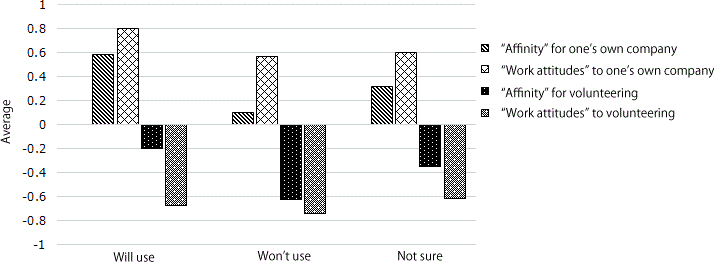
Q25_4. Would you use a system offered by a public institution or company that introduces and matches you with volunteer or social contribution activities? / Introduction or match from one’s current company (single answer)
6. Chapter 6
Challenges in promoting corporate social contribution and volunteer activities and the issue of matching: With focusing on continuity, frequency, and fields of activities
Chapter 6 focuses on how corporate employees develop an awareness of society and a motivation to volunteer, and how they are able to sustain their activities, particularly in the context of the recent emphasis on corporate social responsibility (CSR). It also examines the construction of an environment and measures that will be beneficial to both the company and its employees. The analysis specifically concentrates on the continuity and frequency of volunteer activities.
Analysis results on the relationship between activity outcomes, continuity, and frequency show that the outcomes obtained through volunteering can significantly influence both activity continuity and frequency. The positive relationship between various motivations (e.g., selfishness or altruism; investment-oriented or consumption-oriented) and the continuity and frequency of participation suggests that promoting corporate volunteering in a way that considers employees' personal circumstances and current goals may contribute to its success.
About the types of support measures employees expect from their companies, there is a clear difference between the groups spending more time a year on activities and those spending less when comparing activity frequency. Those with higher frequency tend to consider the balance between volunteer activities and work such as: “Provision of volunteer leaves,” “Relaxation of the rule prohibiting employees from holding secondary or concurrent jobs,” “Encouragement or messages from management or supervisors regarding volunteer activities,” “Points awarded in personnel evaluations or an award system,” “Proper management of working hours (less overtime work),” and “Financial support systems for volunteer activities.” On the other hand, those with lower activity frequency express stronger expectations for opportunities and environments that facilitate initial participation, such as “Being provided opportunities to engage in volunteer activities through training,” “Having peers to work with, such as volunteer clubs,” “Company-wide events such as memorial events are planned and participation is encouraged as part of such events,” and “Internal donation and fundraising activities being conducted within the company.”
Thus, in promoting corporate volunteer activities, it is necessary to construct and evaluate a detailed program that, while considering details such as employees’ motivations and internal evaluation systems, enhance their sense of purpose and willingness to contribute to the society, and at the same time improve their work motivation and skills.
7. Final Chapter
Considering support measures for corporate employees’ social contribution and volunteer activities and their future direction
The final chapter summarizes the research implications from the analysis in the earlier chapters, conducts further analysis of the support measures for volunteering and social contribution activities wished by corporate employees based on these findings and discusses what companies should consider when promoting social contribution activities.
In the additional analysis, four categories were created by cross tabulating the presence or absence of volunteer experience with the presence or absence of the willingness to take part in volunteer activities; the study then examined the specific support measures wished by each group. The results of the analysis showed that among the four categories defined by “Experience” and “Willingness,” the groups with “Experience” and “Willingness” were more likely to seek various types of support, showing a tendency to seek more substantial support through their experiences in those fields. On the other hand, the groups without “Experience” but with “Willingness” tended to look for “Introduction to NPOs, etc.,” “Training,” and “Circles or activity peers,” suggesting that they are seeking support measures to gain a foothold in starting activities.
Policy Implications
Volunteering and social contribution activities for corporate employees are part of a “Parallel Career,” an opportunity to broaden one’s perspective and gain new experiences and challenges. For younger employees, it also offers them a chance to expand their horizons and gain new knowledge and experience. In Japan, even the elderly show a strong drive to pursue new learning, and a notable characteristic is their high motivation for human capital investment. Creating mechanisms for parallel careers that enable individuals to take on new challenges through social participation before mandatory retirement should contribute to a later life filled with purpose and fulfillment.
When developing corporate volunteer programs, companies should strive to understand their employees’ views and expectations toward such activities. It is desirable to set up systems that encourages participation from the planning stage, such as employee-driven, bottom-up ideas, and to provide options for activities that allow employees to engage in social contribution activities in a variety of ways.
Volunteer experience is likely to lead to subsequent participation. The study revealed that even those with no volunteer experience tend to take part in NPOs and other activities when introduced by their own company. Even without a natural affinity for NPOs or volunteer activities, trust in one’s employer serves as a psychological entry point for such activities. While the initial trigger is crucial, a sense of compulsion or duty should be avoided. Forcing participation through a top-down approach—similar to work assignments— not only diminishes motivation but may actually reduce the likelihood of future involvement. As the term “Volunteer” implies, the starting point must be rooted in voluntary initiative.
Contents
JILPT Research Report No.225, full text (PDF:5.4MB) [in Japanese]
Category
Research Period
2022
Researchers
- ONO Akiko
- Vice Senior Researcher, JILPT
- URASAKA Junko
- Professor of Social Studies at Doshisha University
- KAJITANI Shinya
- Associate Professor of Economics at Kyoto Sangyo University
- KOMATA Seiji
- Research Assistant, JILPT
- SHIBUI Susumu
- Professor at National Institution for Academic Degrees and Quality Enhancement of Higher Education
- ISHIDA Yu
- Professor of Business Planning at Miyagi University
(* Please note the titles are as of the time this report was written.)
For Citation
The Japan Institute for Labor Policy and Training (JILPT). 2023. Kigyo de hataraku hito no borantia to shakai koken katsudo: Parareru kyaria no kanosei [Volunteering and social contribution activities by corporate employees: The potential of parallel career]. JILPT Research Report no. 225.
Related Research
- JILPT Research Report No. 142, A study on elderly people’s social contribution activities: Quantitative and qualitative analysis (2012)(PDF:236KB)
- Research Series No. 139, Survey on the activities of NPOs and working styles (organization surveys and individual surveys): With consideration of activities to support reconstruction in response to the Great East Japan Earthquake (2015).
- Research Material Series No. 215, Parallel careers and social contribution activities aimed for lifetime work: Roundtable discussions (interview surveys) with corporate employees. (2019).
- Research Series No. 197, Survey on corporate employees and social contribution activities in the era of the 100-year life (2020).
JILPT Research Report at a Glance
  |
To view PDF files, you will need Adobe Acrobat Reader Software installed on your computer.The Adobe Acrobat Reader can be downloaded from this banner. |